




A shopper at a laptop, shopping icons floating over the keyboard

AI Platform Engineering

AI for E-commerce

AI inside the store you already run, from search to checkout.

We engineer AI into the store you already run: search that understands what a shopper means, an assistant that knows your catalogue and your policies, product content your team approves before it goes live, and a checkout AI agents can use.

Inside your store, under your control

Each feature is wired into the catalogue, cart and order systems you already run, and every release is tested against your own cases before a shopper sees it.

linen outfit for a summer wedding, with a yellow bag

  • A hand choosing clothing on a transparent wardrobe screen

    Relaxed linen shirt

    In stock in your size

  • An isometric mobile shop with parcels and a 'buy now' screen

    Top-handle bag, saffron

    Matches your search
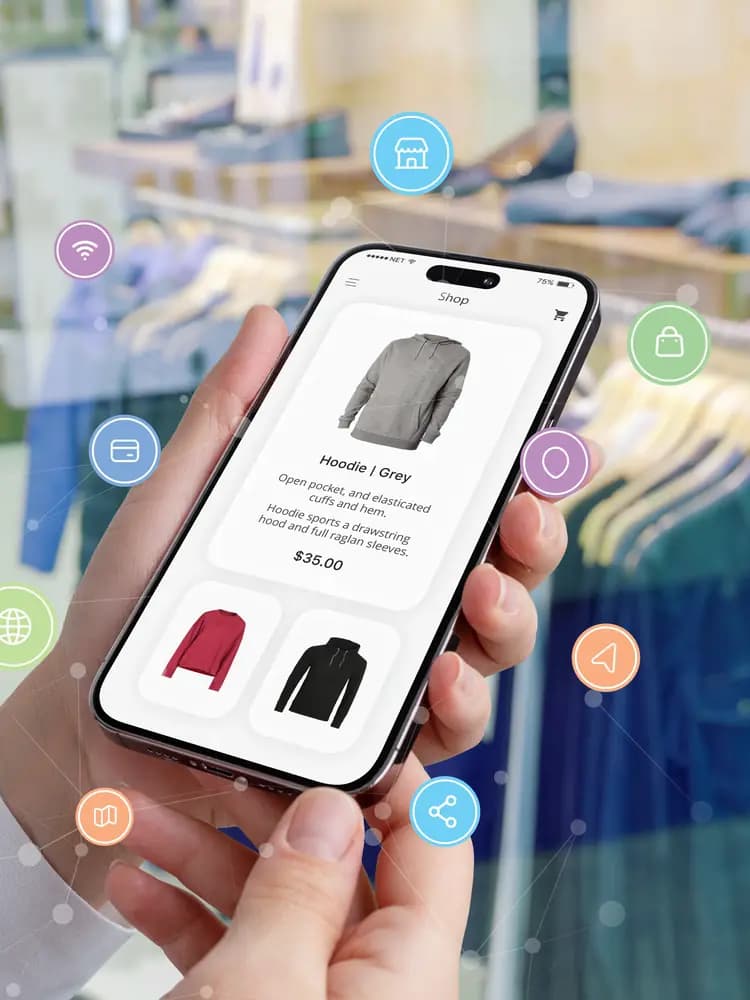
  • A phone in a shopper's hands showing a jacket, the boutique rail behind it

    White chunky sneaker

    Seen in your photo

  • A laptop with a shopping cart, search and tag icons over the keyboard

    Summer fragrance

    Often bought together

Search that understands

A shopper's sentence becomes the right shortlist, ranked for relevance, stock and your merchandising rules.


  • AssistantYour size is in stock and can reach you by Thursday. Shall I add it to your cart?
  • ShopperDo the linen shirts run small? I'm usually between sizes.
  • AssistantThey fit true to size. Reviewers who like a looser fit suggest one size up.

Shopping assistant

Answers from your catalogue, policies and orders, and hands over to your team when it should.

Top-handle bag, saffron

Structured top-handle bag in crocodile-embossed leather, with a silver clasp and a detachable strap.

Content your team approves

Titles, descriptions and attributes are drafted from your data and wait for a person before they go live.

  1. Release 12Live
  2. Release 13Passed
  3. Release 14Held back
  4. Release 15Testing

Every release tested first

Search, ranking and assistant changes are checked against your own cases before shoppers see them, and the last good release is one step back.

What we engineer into a store

The pieces we build most often. Each one connects to your catalogue, inventory, orders and payments, and each one is judged on your own data.

  • Search and discovery

    Keyword and semantic search together, with autocomplete, typo and synonym handling, and ranking that respects stock, margin and merchandising rules. Shoppers can type the way they talk.

  • Recommendations and personalisation

    “Pairs with”, “complete the look” and returning-visitor shelves built from behaviour and catalogue data, with rules your merchandisers can read and override.

  • Visual search

    A shopper photographs something they like and gets the closest matches you sell, in stock and in their size.

  • Shopping assistant

    A conversational assistant on your site and messaging channels that answers from your catalogue, policies and order data, acts within limits you set and hands over to your team.

  • Product content and catalogue enrichment

    Titles, descriptions, attributes and translations drafted from supplier data and images, checked against your style guide and approved by a person before publishing.

  • Reviews, questions and summaries

    Review highlights and answers to product questions, grounded in what customers actually wrote, with the source one click away.

  • Virtual try-on

    Try-on for apparel, eyewear and beauty built on your own product images, so shoppers can judge fit and shade before they buy.

  • Fraud, returns and risk

    Signals that flag risky orders and likely returns before dispatch, with the reason shown to the person who decides.

  • Quick commerce and substitutions

    Store-level availability, sensible substitutions when an item runs out, and delivery promises your operations can keep.

A hand holding a credit card beside a laptop showing an online store

Agentic commerce

When the shopper is an AI agent

Shoppers are starting to buy through assistants that search, compare and check out for them. Open standards for this are arriving from the large platforms and payment networks, among them Google's Universal Commerce Protocol and the Agentic Commerce Protocol from OpenAI and Stripe.

We make a store readable and buyable by those agents: a clean, structured catalogue, an MCP server over products, cart and orders, verified agent checkout, and the rules that decide what an agent may do.

How we build AI agents

From one feature to a platform

Most stores start with one feature on one channel. We build it inside your stack, prove it on your data and hand it to your team.

  1. 01

    Scope

    A short readiness sprint in your catalogue, analytics and order data to choose the first feature and agree how it will be judged.

  2. 02

    Build

    Engineers work in your repositories and your cloud, wiring the feature into the catalogue, search, cart and order systems you already run.

  3. 03

    Prove

    We test on your own cases before launch, then release to a share of traffic and watch the measures you chose, with a rollback ready.

  4. 04

    Hand over

    Runbooks, dashboards and a trained team. You own the code, the prompts and the evaluation set; we can stay on to run it if you want.

Frequently asked questions

Do we have to change platforms to add AI to our store?

No. We build on the platform you run, whether that is Shopify, Adobe Commerce, Salesforce Commerce Cloud, WooCommerce or a custom stack, through its APIs and in your own cloud. Each feature ships as a service your storefront calls.

Which feature should we start with?

Usually the one closest to revenue and easiest to measure: search, recommendations or product content. The readiness sprint compares candidates on your own data and picks one with a clear way to judge it.

How do you stop the assistant from making things up?

It answers only from your catalogue, policies and order data, shows where an answer came from, declines what it cannot ground and hands over to a person on topics you set. Every release is tested against your own question set before it goes live.

Who owns the models, prompts and data?

You do. The code, prompts, evaluation sets and any fine-tuned weights are yours, in your repositories and your cloud. We build on open or hosted base models you approve.

What is agentic commerce, and do we need it now?

It is shoppers buying through AI assistants that act for them. The standards for agent checkout are still settling, so we start with what pays off either way: a clean, structured catalogue and an interface agents can read. The checkout pieces follow when your channels support them.

Can you work alongside our in-house team?

Yes. Most engagements pair our engineers with yours, inside your repositories and stand-ups, and end with your team running what we built. Forward-deployed engineering is the model for that.
A laptop showing 'Shopping Online' beside a credit card and a straw hat

Tell us about your store

Tell us the platform you run and the feature you have in mind, and we will come back with a first view of how we would build it.

  1. 01The platform you run, and the systems around it
  2. 02The feature you have in mind, or the problem behind it
  3. 03How you would judge it working