

 01
01Physical & operations · 14
The plumbing every model above depends on.
Tested pipelines, a store chosen for the workload, features shared by training and serving, and the infrastructure, CI and registry that turn a model from a notebook into something that runs every night and pages someone when it does not.
For teams whose models are blocked by data that arrives late, breaks quietly or cannot be trusted, and for teams who have a model that works but no way to keep it working.
01Overview
DataMost model failures are data failures. We build pipelines that are owned and tested like application code, choose the storage the workload actually needs, share features between training and serving, and check every table for lineage and quality before anything reads from it.
01/ 02
Data
Data that arrives on time, tested, and traceable.
Most model failures are data failures. We build pipelines that are owned and tested like application code, choose the storage the workload actually needs, share features between training and serving, and check every table for lineage and quality before anything reads from it.
- 01
Pipelines that are tested and owned
Every pipeline has an owner, a test suite, a schedule and an alert. Schema changes upstream fail a test before they corrupt a table, and a late source is known before the dashboard is wrong.
- 02
Warehouse or lakehouse, chosen for the workload
Analytical queries, model training, event streams and document stores have different shapes. We choose between a warehouse, a lakehouse and the combination on the basis of your queries, your volumes and your budget, and we show the working.
- 03
Feature stores shared by training and serving
A feature computed one way for training and another way for serving is the commonest cause of a model that worked in evaluation and fails in production. One definition serves both, with point-in-time correctness for training sets.
- 04
Lineage and quality checks on every table
Each table records what it was built from and by which run, and carries freshness, volume, null-rate and distribution checks. A number in a report can be traced to its source, and a bad load is caught before it is read.
02/ 02
MLOps
From notebook to production, and staying there.
A model in production is infrastructure, a release process, a registry and a rota. We build the training and serving paths, put models through the same CI as code, keep one registry that knows what is live, and design cost and on-call in from the start rather than discovering them in the first invoice.
- 05
Training and serving infrastructure
Training jobs on the GPUs you have or rent, with checkpoints and reproducible environments; serving on autoscaled endpoints, batch jobs or edge devices, sized to your traffic and your latency budget.
- 06
CI for models, not just code
A model change runs the evaluation suite, the data checks and the integration tests before it can be promoted, the same way a code change runs its tests. A regression fails the pipeline rather than reaching a customer.
- 07
A registry that knows what is in production
Every model version, its training data snapshot, its evaluation results and where it is deployed live in one registry. Rolling back is choosing the previous version, and answering "which model made this decision" takes one lookup.
- 08
Cost and on-call in the design
Serving cost per prediction and training cost per run are estimated before build and reported after, per model. Alerts, runbooks and a rota are part of the delivery, whether your team or ours holds the pager.
At a glance
Every capability, at a glance
8 figures, one per capability. Open any to read it in full.

How it runs
From first call to running unattended
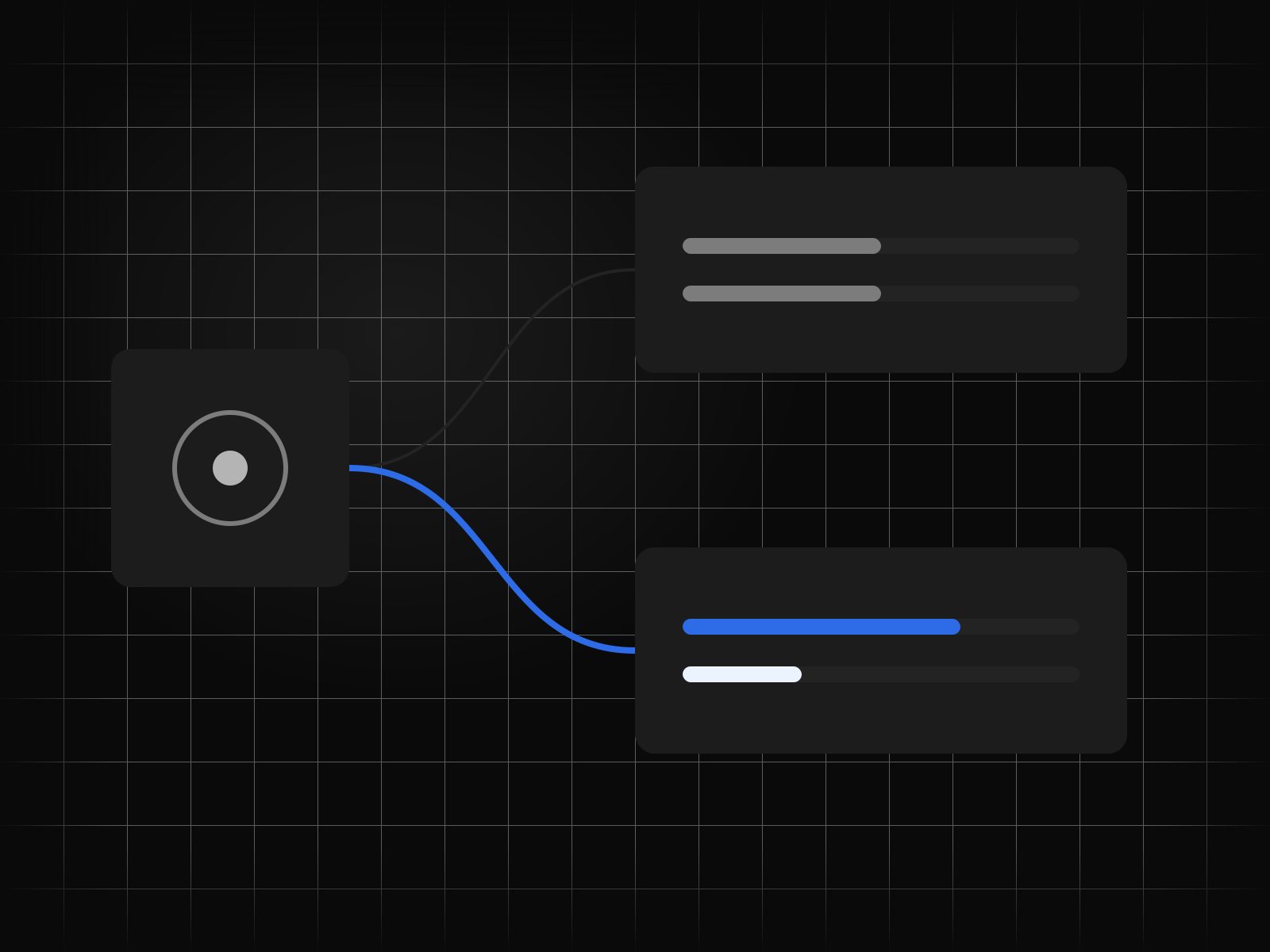
Every engagement runs the same five steps, whatever the service.
- 01
Map the process
We sit with the people who do the work today and write down every step, exception and hand-off before anything is built.
- 02
Build against a golden set
A held-out set of real cases, agreed with you, is the bar each build has to clear before it goes anywhere near production.
- 03
Run beside the team
The system runs in parallel with the team for as long as it takes, and every disagreement between them is reviewed together.
- 04
Hand over the keys
The code, the prompts, the evaluation set and the runbooks are handed over in your accounts, under your keys.
- 05
Keep it running
We watch the runs, retrain and repair as the inputs drift, or train your own team to do the same.
Outcomes
What this looks like when it lands.
01 Pipelines that fail loudly and early
A broken source is caught by a test and an alert before it reaches a table, a model or a report.
02 One definition of every feature
Training and serving read the same feature store, so the model that passed evaluation is the model that runs.
03 A model release that looks like a code release
Evaluated, tested, registered, promoted and reversible, with its cost known before it ships.

Details
On the spec sheet.
- Service
- Data Engineering & MLOps
- Group
- Physical & operations
- Capabilities
- 8
- Engagement
- Map, build, run beside the team, hand over, keep running
- Ownership
- Your accounts, your keys, your region
Questions we are asked about data engineering and MLOps
Asked before signing.
Which platforms do you work with?
The major clouds and the common warehouse, lakehouse and orchestration tools. We choose on the basis of your workload and what your team already runs, and we avoid introducing a tool that only we know.
We already have a data team. Where do you fit?
Alongside them. We usually take the model-facing parts, feature stores, training and serving paths, CI and the registry, and leave the platform in their hands with what we build documented in their conventions.
Can you take over pipelines that already exist?
Yes. We start by putting tests and lineage around what exists, so failures become visible, and only then change what needs changing.
How is cost controlled?
Estimated per model before build, reported per model after, with budgets on training runs and autoscaling limits on serving. The number is on a dashboard, not in a surprise invoice.
Who is on call?
Whichever you prefer. The alerts, runbooks and rota are delivered either way, and our autonomous operations service can hold the pager for you.
Start